Fitting a Planetary transit
In this example we show the usage of an initialization function, to optimize the evaluation of the fitness function.
The goal is to build a simulated Light Curve (flux level of a star over time), with a dip in it (caused by a planet blocking part of its light, on our line of sight). To do so, we must first build a model capable of simulating such an event:
import batman
import numpy as np


    def calculate_period(a, RS, MS):
        G = 6.67408e-11
        M_sun = 132712440018 * 1000 ** 3 / 6.67408e-11  # Kg
        R_sun = 696342e3  # meters
        return np.sqrt(4 * np.pi ** 2 * (a * RS * R_sun) ** 3 / (G * MS * M_sun)) / (
            24 * 3600
        )

    def init_transit_model(transit_params, time, star_params ):
        """
        Creates the batman model using the desired values.
        """
        params = batman.TransitParams()  # object to store transit parameters
        params.t0 = transit_params["t0"]  # time of inferior conjunction
        params.per = calculate_period(transit_params['a'], RS=star_params['star_radius'], MS=star_params['star_radius'])  # orbital period
        params.rp = transit_params['r_p']  # planet radius (in units of stellar radii)
        params.a = transit_params['a']  # semi-major axis (in units of stellar radii)
        params.inc = transit_params['inc']  # orbital inclination (in degrees)
        params.ecc = 0.  # eccentricity
        params.w = 90.  # longitude of periastron (in degrees)
        params.limb_dark = star_params['limb_type'] # limb darkening model
        params.u = star_params['limb_coefs'] # limb darkening coefficients [u1, u2, u3, u4]

        m = batman.TransitModel(params, time)  # initializes model
        return m, params


    def create_transit_model(model, params):
        """
        Creates a light curve array with the model and chosen parameters
        """
        return model.light_curve(params)


    def edit_transit_params(params, p, star_radius, star_mass):
        """
        Changes the batman TransitParams that are being fitted for the new parameters
        """
        params.rp = p['r_p']  # planet radius (in units of stellar radii)
        params.a = p['a']  # semi-major axis (in units of stellar radii)
        params.inc = p['inc']  # orbital inclination (in degrees)
        params.t0 = p['t0']   # time of inferior conjunction -> center of lightcurve
        params.per = calculate_period(p['a'], RS=star_radius, MS=star_mass)
        return params

    def pre_process_LC(time, flux):
            """
                    Center the Light Curve on the minimum point
            """
        time = time - time[np.argmin(flux)]
        return time, flux
Using this model, we now build a Light Curve with know parameters and add noise to it:
star_params = {
    'star_radius': 1.0,
    'star_mass': 1.0,
    'limb_type': 'quadratic',
    'limb_coefs': [0.36, 0.3]
}


transit_params = {'r_p': 0.08,
                    'a': 2.1,
                    'inc': 87,
                    't0': 0.05
                }

times = np.linspace(0, 0.1, 200)

model_tra, params_tra = init_transit_model(transit_params, times, star_params)

curve = create_transit_model(model_tra, params_tra)


yerr = 0.001 * np.random.rand(200)

y_noisy = curve + yerr * np.random.randn(200)
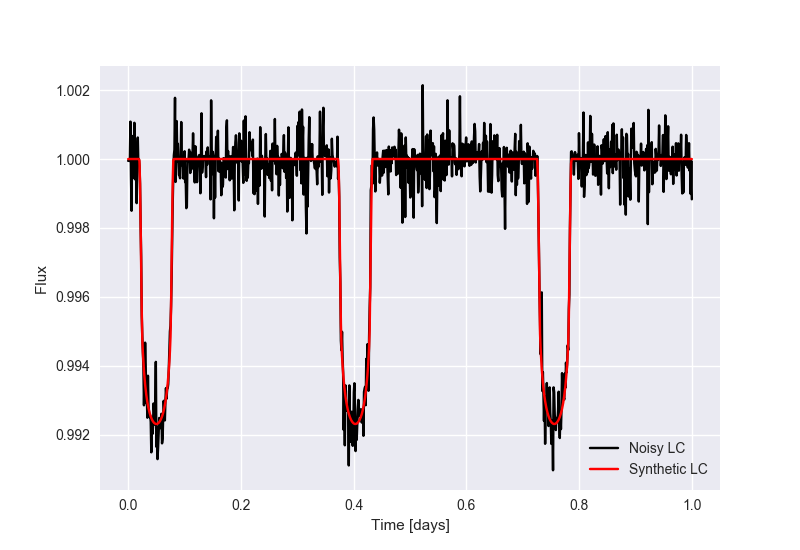
The data that we will use as input for our model will be:
Now we proceed to define the initialization function and the fitness function:
import numpy as np
from rues import  Genetic

    def fitness(data_x, data_y, ind_parameters, initial_config, **kwargs):

        star_params = kwargs['star_params']
        params = edit_transit_params(initial_config['batman_params'], ind_parameters, star_params['star_radius'], star_params['star_mass'])
        curve = create_transit_model(initial_config['batman_model'], params)
        residuals = data_y - curve

        return 1/np.sum(np.abs(residuals))

    def initial_setup(X, Y, **kwargs):
        transit_params = {'r_p': 0.01,
                            'a': 1.1,
                            'inc': 10,
                            't0': 0
                        }   # just to create a default light curve

        model, params =  init_transit_model(transit_params, X, kwargs['star_params'])
        initial_config = {'batman_params': params, 'batman_model': model}
        return initial_config
,the parameter space limits:
param_limits = {'r_p':[1e-3, 1],
                 'a':[1e-3, 6],
                 'inc': [0, 90],
                 't0': [-time[0], time[-1]]

                 }
, configure the population:
configuration_dict = {
    'keep_alive': True,
    'offspring_ratio': 0.90,
    'mutate_prob': 0.25,
    'processes': 6,
    'crossover_type': 'blend',
    'alpha_value': 0.5,
    'mutation_type': 'uniform',
    'reinsertion_type': 'age',
    'selection_type': 'tournament',
    'tourn_size': 32,
    'worker_params': {'fit_func': fitness, 'initial_setup': initial_setup, 'star_params':star_params},

}
Now we initialize the model and wait until the desired generation is met:
time, flux = pre_process_LC(times, y_noisy)
pop = Genetic(700, param_limits, configuration_dict)
pop.fit(time, flux, 300)
Afterwards, plot the results:
    fitted_params = pop.get_optimal_params()
model_tra, params_tra = init_transit_model(transit_params, time, star_params)

curve = create_transit_model(model_tra, params_tra)

fig, axes  = plt.subplots(2,1)


for index in [0,1]:

    axes[index].plot(time, y_noisy, color = 'black', label = 'input: with noise')
    axes[index].plot(time, curve, color ='red', label = 'Best fit')
    axes[index].plot(time, real_y, color = 'blue', label = 'input: noise free')

    if index == 1:
        axes[index].set_xlim([-0.43, -0.28])
        axes[index].set_ylim([0.99, 1.002])


    axes[index].set_xlabel("Time [days]")
    axes[index].set_ylabel('Flux')

plt.show()
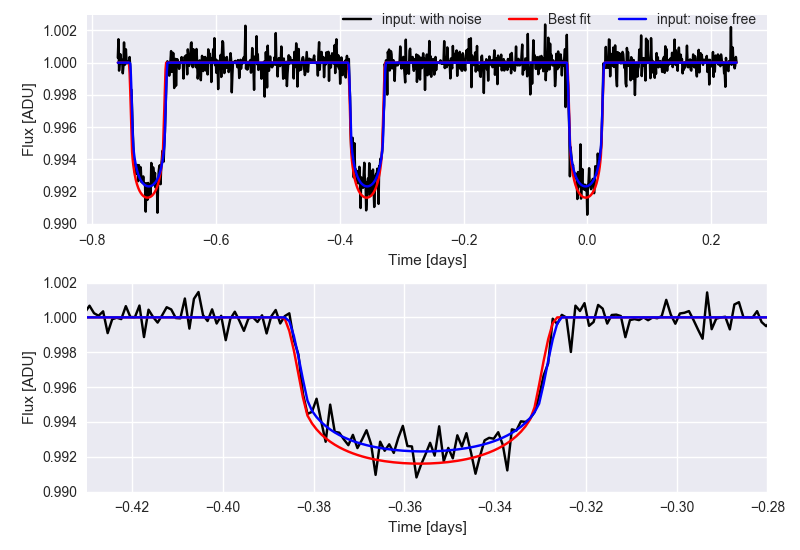
Even though the final result is not a perfect match against the “noise free” Light Curve, we see that the fitted model closely resembles the noisy data that we use for the fit.