How to control rues
In order to use the library the user must define the fitness function (which will drive the optimization routine), and configure the overall behaviour of the population (selection, crossover, mutation and re-insertion)
The Fitness Function
The fitness function will drive the evolution of the population (higher fitness correspond to better solutions).
This function must always have the following format:
def fitness(data_x, data_y, ind_parameters, initial_config, **kwargs):
The first two arguments, data_x and data_y will be the data that we are trying to fit (i.e. the input data). Afterwards we have access to the ind_parameters, the parameters of the individual as a dictionary. The keys of this dictionary are the names of the genes of the individual, as explained in The Population . The initial_config argument is a dictionary, described in more detail in Initialization of the model and the kwargs are described in the The Population. Even if there is not an initialization routine to be performed, this parameter needs to exist, as it will be passed to this function (albeit with no real use).
Initialization of the model
If our model needs to perform an initialization routine, i.e. run something (only one time) before evaluating the fitness function for the entire population, we can initialize it beforehand. As the fitness function is evaluated (for different individuals) in parallel (multiple cores at once) we must explicitly define an initialization routine, that will work as in the following Figure:
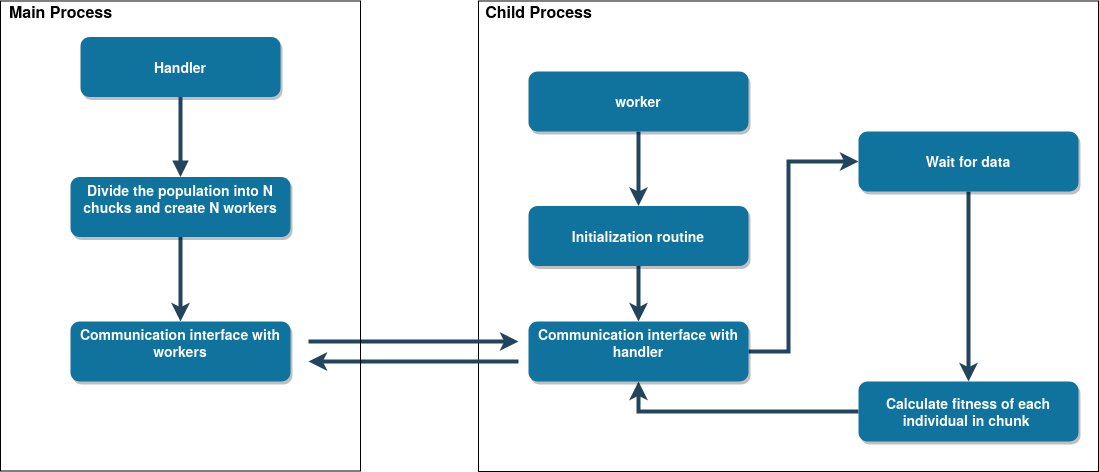
This initialization function must conform to the following format:
def initial_setup(X, Y, **kwargs):
        # place code here
    initial_config = {'foo': 1, 'bar': 1}
    return initial_config
X and Y are the data that is going to be fitted and the kwargs are the ones that will eventually reach the worker, as described in The Population
The output of this function must be a dictionary, that will then enter the fitness function, described in The Fitness Function
The Population
The population is also configured by a dictionary, with most of the keys being “fixed” and some must be included under some conditions. A typical configuration dictionary looks like this:
configuration_dict = {
    'keep_alive': True,
    'offspring_ratio': 0.90,
    'mutate_prob': 0.25,
    'processes': 6,
    'crossover_type': 'blend',
    'mutation_type': 'uniform',
    'reinsertion_type': 'age',
    'selection_type': 'tournament',
    'tourn_size': 32,
    'worker_params': {'fit_func': fitness, 'initial_setup': initial_setup},

}
Going over them one by one:
keep_alive : maintain the multiple processes alive until the last generation is computed. Otherwise new processes will be launched at each generation
processes: number of processes that will be launched to evaluate the fitness function
offspring_ration: percentage of the population that will be created as offspring
mutate_prob: mutation probability of each individual when it is created
crossover_type: Possibilities:
blend : blend crossover; If chosen, the configuration_dict must also have the key ‘alpha_value’
K_point : K-point crossover; If chosen, the configuration_dict must also have the key ‘K_value’
mutation_type: type of mutation. Currently only support the uniform mutation
reinsertion_type: keep (1 - offspring ration) % of the previous population following the routineS:
age : keep newest individuals
fit : keep fittest individuals
selection_type: choose selection algorithm:
tournament : Tournament selection. If chosen, the ‘tourn_size’ (tournament size) must also be passed
roulette : roulette wheel selection
universal_sampling : stochastic universal sampling
worker_params: Information that will reach each worker:
‘fit_func’ : fitness function, described in The Fitness Function
‘initial_setup’ : Initialization routine, described in Initialization of the model. must either be a function or None
One can add extra parameters to this dictionary, to both reach the initialization routine and the worker
Lastly, we need to initalize the population:
    limits = {'foo': [0, 100], 'bar':[0,100]}

population = Genetic(pop_size, limits, configuration_dict)
Where pop_size is the number of elements in the population, limits is a dictionary that attributes the names to the parameters and defines the limits of the parameter space and configuration_dict is the dictionary with the worker configurations.
Optimizing the model and results
Lastly, we run the optimization routine, by passing the data and the maximum number of generations.
population.fit(X = data_x, Y = data_y, max_iterations = 200)
To retrieve the results we can create a corner plot:
population.create_corner()
Retrieve the optimal parameters (highest fitness):
population.get_optimal_params()
Retrieve the entire population, sorted by fitness level (from lowest to highest):
population.get_sorted_population()
This will return a list with each individual inside it. To get data from the individuals:
individual = population.get_sorted_population()[-1]  # element with the highest fitness

# fitness level:
fitness = individual.score

# dictionary equal to the one returned by population.get_optimal_params()
parameters = individual.parameters
More information and examples are given in the Sinusoidal fit Section and beyond.